
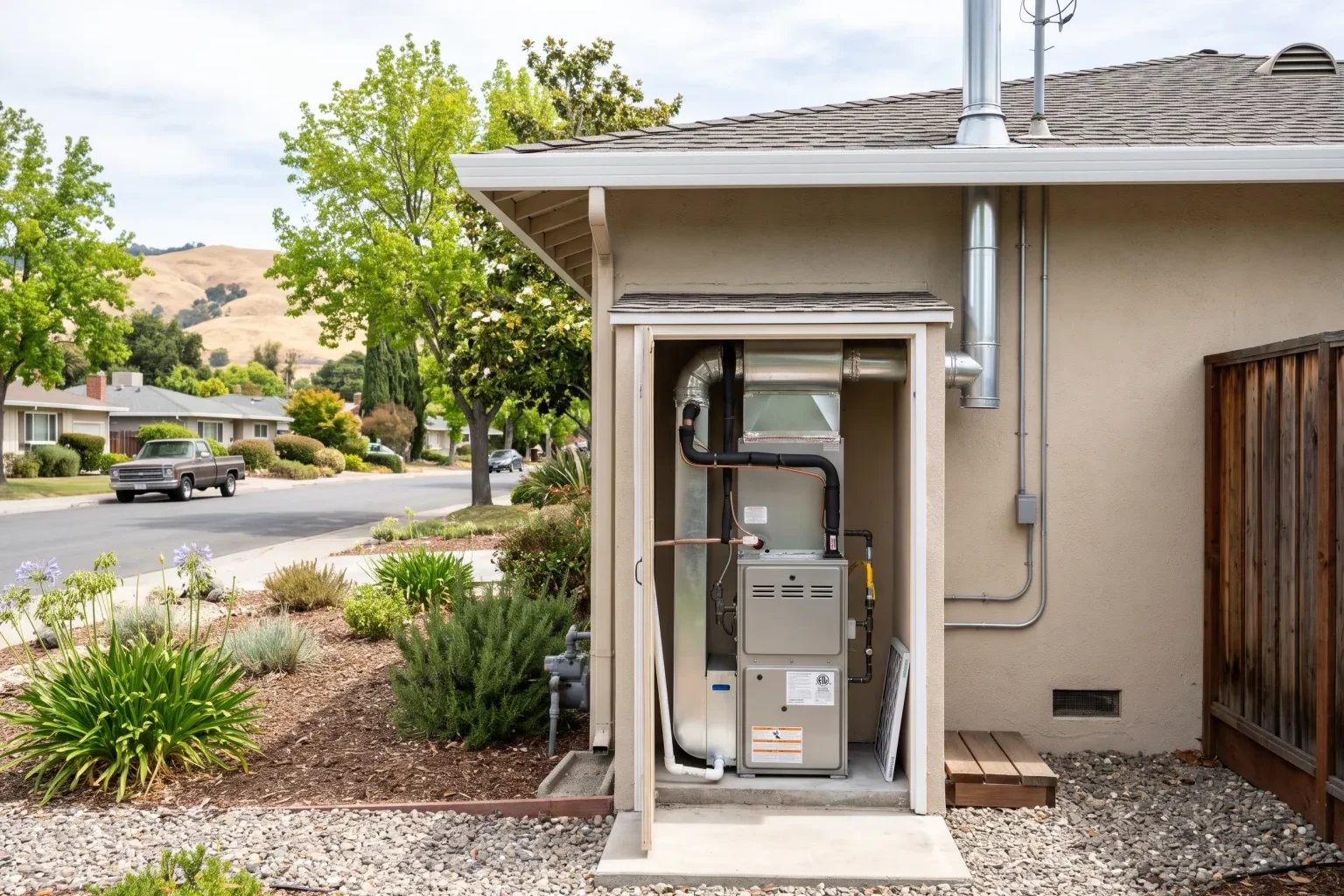
The short answer
If your heater won't start, blows cool air, cycles on and off, makes new noises, or runs up your energy bill, it likely needs a diagnosis and repair. Most heating problems can be fixed, and current Bay Area rules don't require you to replace a working furnace. Replacement mainly makes sense for older, failing systems with repeated or major repairs.
Winters in the Santa Clara Valley are mild and damp, so most home heating systems sit idle for months and then get pushed hard on cold mornings and rainy evenings. That on-and-off pattern is when problems tend to appear: a furnace that won't light after a long break, a heat pump that blows lukewarm air, or a system that runs constantly without warming the house. CoolVantage AC Repair diagnoses and repairs gas furnaces, heat pumps, and the thermostats and ductwork that connect them for homeowners in San Jose, Santa Clara, Sunnyvale, Campbell, Milpitas, Cupertino, and surrounding communities. This page covers the signs that point to a repair, what our technicians check, how to weigh repair against replacement, and what to expect from a visit.
Signs Your Heating System Needs Repair
Heating problems usually start small. Catching them early can keep a minor fix from turning into a breakdown on the coldest night of the year. Call for service if you notice any of the following:
- The system won't turn on, or the furnace tries to light and then shuts off
- Air from the vents feels cool or only slightly warm
- Some rooms stay cold while others are comfortable
- The heater turns on and off every few minutes (short cycling)
- New sounds such as banging, squealing, grinding, or rattling
- A burning or dusty smell that lasts beyond the first few minutes of the season
- Your energy bill jumps without a change in how you use the heat
- The thermostat doesn't respond or doesn't match the actual room temperature
- A heat pump stays iced over or switches to emergency heat often
- If you smell gas or your carbon monoxide alarm sounds, leave the house right away and contact your gas utility or 911 before calling for repair.
What We Check During a Heating Repair Visit
A good repair starts with finding the actual cause, not just the symptom. Our technicians work through the system in a logical order so the fix addresses what's really wrong.
For gas furnaces, that includes the ignition and burner assembly, the flame sensor, the heat exchanger, venting, and safety switches. For heat pumps, we look at refrigerant pressures, the reversing valve, the defrost controls, and the outdoor coil. On every system, we check the following:
- Thermostat settings, wiring, and calibration
- Air filter condition and airflow through the system
- Blower motor, capacitor, and fan operation
- Electrical connections, fuses, and control board
- Condensate drain and pump on high-efficiency furnaces
- Visible ductwork for disconnections or major leaks
- Venting and combustion safety on gas equipment
Repair or Replace: How to Decide
Most heating problems can be repaired. Failed igniters, dirty flame sensors, worn capacitors, clogged filters, and thermostat faults are common and usually straightforward to fix. If your system is in reasonable shape, repair is often the sensible choice.
Replacement is worth considering when a system is older, needs a major component such as a heat exchanger or compressor, has needed several repairs in a short period, or no longer keeps the house comfortable. After the diagnosis, we'll explain what we found and lay out your options so you can decide without pressure.
Local rules are part of the picture, but they don't force your hand. The Bay Area Air District's appliance rules don't require you to replace working equipment; they apply only when an existing furnace or water heater fails or is replaced. Under the Air District's Rule 9-4, natural gas furnaces manufactured from 2029 must meet a zero-NOx emission standard, which in practice points homeowners toward heat pumps for furnace replacements after that date. If you're replacing a system anyway, it can make sense to compare a heat pump now.
On incentives: the federal Energy Efficient Home Improvement Credit (25C) covered qualifying heat pumps placed in service before December 31, 2025, and isn't available for new installations after that date. Bay Area homeowners can still check BayREN and their local clean energy provider for current heat pump and electrification incentives. Amounts and availability change by funding cycle, so we confirm the current offer before including it in a quote.
What Affects the Cost of Heating Repair
Every repair is different, and we provide a clear quote after diagnosing the problem and before starting work. The main factors that affect cost include:
- The type of system: gas furnace, heat pump, or a combination
- Which part has failed and whether it's a common or specialty component
- Equipment age and how easy it is to find compatible parts
- Where the unit is located, such as an attic, crawl space, closet, or garage
- Whether the problem involves refrigerant, electrical, or gas components
- How much time diagnosis and the repair itself take
- Whether related issues, like duct damage or a failing thermostat, should be addressed at the same time
How a Heating Repair Visit Works
We try to keep the process simple and predictable from the first call to the final check.
When you contact us, we'll ask about your system and what you're noticing so the technician arrives prepared. On site, the technician listens to your description, inspects the system, and runs diagnostics to find the cause. Before any repair begins, we explain the problem in plain terms, describe your options, and give you a quote. Nothing proceeds until you approve it.
Once the repair is done, we test the system through a full heating cycle, check that it operates safely, and walk you through what we did. If we notice anything worth watching, such as a part nearing the end of its life, we'll tell you so you can plan ahead. Changing your filter regularly and scheduling a tune-up before the cooler months can help prevent many of the problems we see.
Heating Repair by city
- Heating Repair in Los GatosLocal service & repairs
- Heating Repair in CampbellLocal service & repairs
- Heating Repair in Monte SerenoLocal service & repairs
- Heating Repair in Morgan HillLocal service & repairs
- Heating Repair in SaratogaLocal service & repairs
- Heating Repair in Santa ClaraLocal service & repairs
- Heating Repair in MilpitasLocal service & repairs
- Heating Repair in CupertinoLocal service & repairs
- Heating Repair in SunnyvaleLocal service & repairs
- Heating Repair in Scotts ValleyLocal service & repairs
- Heating Repair in Los AltosLocal service & repairs
- Heating Repair in Mountain ViewLocal service & repairs